
Valentine’s day lessons from spiders:
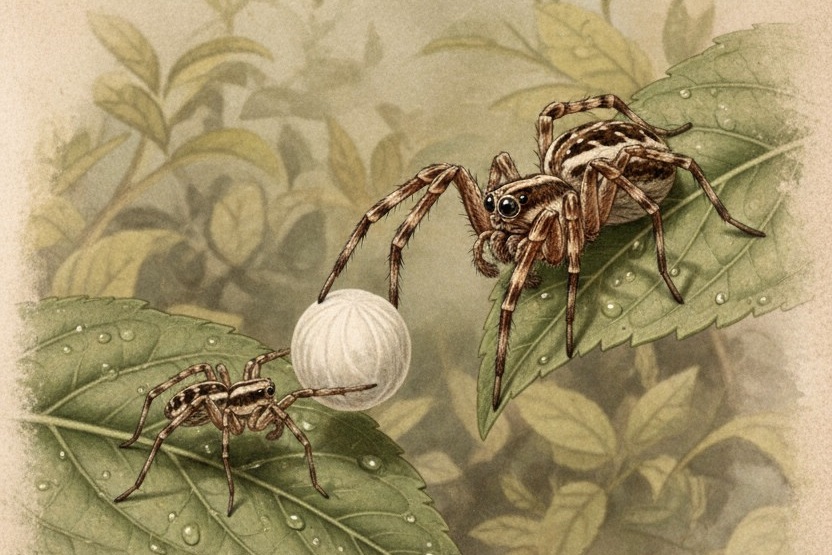
In the human world, Valentine’s Day is a high-stakes dance of dinner reservations and overpriced floristry. But if you think the pressure to find the perfect gift is intense, be glad you aren’t a male Nursery Web spider.
Long before humans romanticised gifting, the wild had already perfected the art sometimes with far higher stakes. In the world of spiders, a gift can mean the difference between passing on your genes…or becoming dinner.
In the animal kingdom, behaviour is rarely about sentiment and very often about economics. Welcome to the world of nuptial gifting, where romance is a survival strategy. In some spider species, especially the nursery web spiders, males arrive at a date bearing a carefully prepared gift which is usually a prey item, neatly wrapped in silk. To us, it may look like a simple offering. To a female spider, it signals effort, hunting ability and nutritional value. To the male spider, it is a carefully calculated survival strategy.
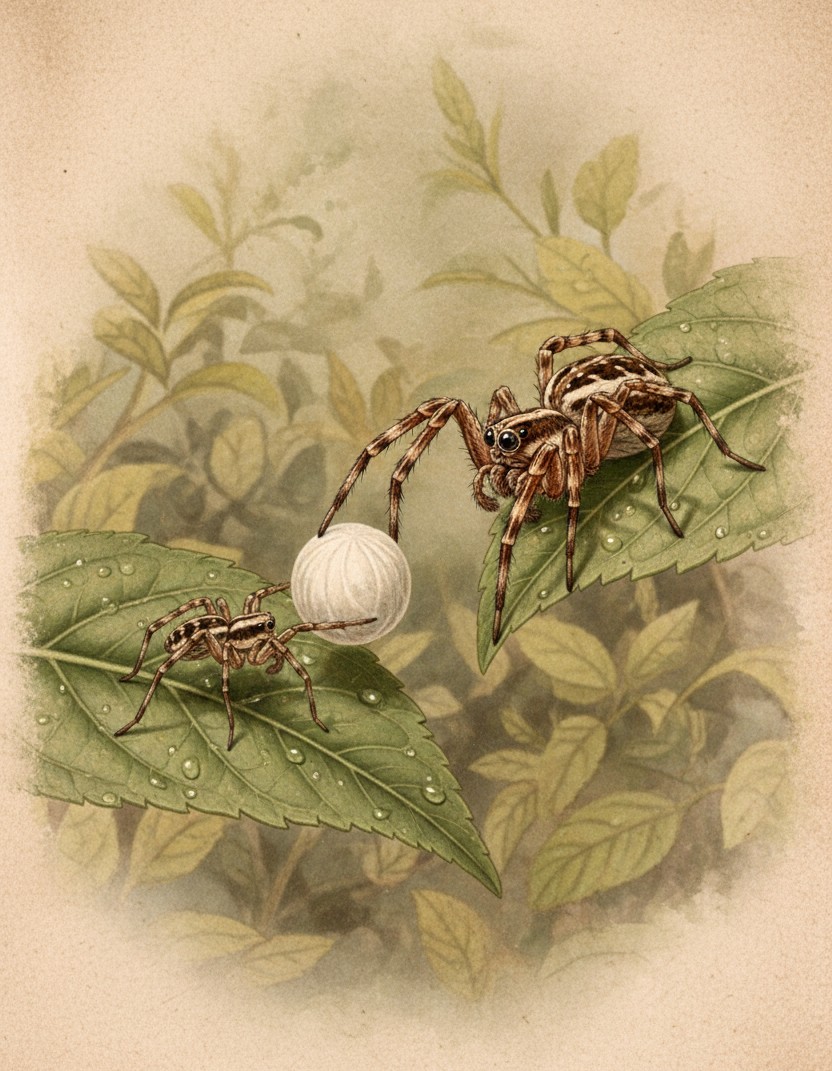
Here’s the catch: female spiders are often larger, stronger and not particularly sentimental. A hungry female is perfectly capable of eating her suitor instead of mating with him. The nuptial gift acts as both distraction and persuasion. While the female is busy unwrapping and feeding, the male seizes his moment to mate alive.
Let’s unpack what’s really happening here:
- The appetizer effect: A hungry female can be dangerous. By providing a snack, the male ensures she is busy eating a fly rather than him.
- The stopwatch strategy: Evolution is a numbers game. The larger the gift, the longer it takes her to eat it. This gives the male more time to complete the mating process. In spider terms, a bigger box of chocolates literally buys you more “quality time.”
Some species take this behaviour to impressive extremes. Males may spend considerable time hunting the right prey and wrapping it elaborately in silk, enhancing its appeal. Others have evolved darker tricks like offering empty silk parcels, inedible items or prey remains.
Behavioural biologists have observed so-called “worthless” gifts such as dried leaves, insect husks or scraps wrapped in thick, pristine silk. This is deceptive signalling at its finest. The male relies on the visual appeal of the packaging to get his foot in the door. By the time the female realises she has been handed the spider equivalent of an empty iPad box, the male has often already completed mating and made his exit.
Observations shows that while females prefer “real” gifts, the males who bring “worthless” ones still fare better than those who show up empty-handed. In the wild, it really is the thought (or at least the packaging) that counts.
What unfolds is not romance in the human sense, but something equally fascinating. It is a finely tuned negotiation shaped by survival and reproduction. The gift is not symbolic. It is functional, strategic and deeply ecological. It reflects energy budgets, predator–prey dynamics and the constant tug-of-war between risk and reward.
So, this Valentine’s Day, as we wrap presents and plan gestures of affection, it’s worth remembering that gifting is not uniquely human. In the undergrowth, beneath leaves and along silken threads, spiders have been perfecting the art of courtship for millions of years.
It is a world where love comes wrapped in silk and rejection can quite literally cost you your life.