A baseline assessment of potentially toxicLutrogale perspicillata) spraints(Lutrogale perspicillata) spraints from the estuarine landscape of Goa, India. Chemistry and Ecology, 1–12
Dias, S. J., D’Costa, J., Ainkar, S. S., Sinai Borker, A., & D’Costa, A. H. (2026)
Abstract
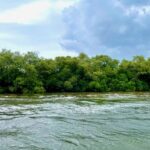
Apex predators are effective indicators of bioaccumulation and biomagnification of xenobiotics. In this study, we determined the concentrations of eight potentially toxic elements (PTEs) (Pb, Cd, As, Cu, Zn, Mn, Fe, Cr) in the faeces (spraints) of smooth-coated otters (Lutrogale perspicillata) from the Mandovi-Zuari estuarine complex, Goa, India. Sampling was conducted at two locations: Study site-1 in the Mandovi estuary and Study site-2 in the Zuari estuary. Both rivers originate in the Western Ghats and are characterised by similar anthropogenic influences, including agriculture, urban expansion, and industrial activity. Three spraint samples were collected from each site and analysed for PTEs using Atomic Absorption Spectroscopy (AAS). The mean concentrations of PTEs (mg/kg d.w.) at study site-1 were as follows: Fe (365.4) > Zn (174.3) > Cu (38.5) > Mn (26.8) > Cr (21.4) > Pb (8) > Cd (2.3) > As (0.1). The mean concentrations of PTEs (mg/kg d.w.) at Study site-2 were as follows: Zn (167) > Fe (60.6) > Mn (45) > Cu (28) > Cr (20.2) > Pb (7.7) > Cd (2) > As (0.2). This study provides valuable preliminary insights into the exposure of L. perspicillata to PTEs in the estuarine landscape of Goa, India.
Seasonal diet of the smooth-coated otter (Lutrogale perspicillata) in traditional brackish-water agroecosystems of Goa, India. Aquatic Ecology, 59, 1299–1318
Dias, S. J., Borker, N. S., Yadav, A. K., D’Costa, J., Borker, A. S., & Porob, P. C. (2025)
Abstract
The diet of the smooth-coated otter (Lutrogale perspicillata) was assessed in a representative agro-ecosystem complex called “Khazan Lands”, situated within the human-dominated estuarine landscape of the Zuari River of Goa, India. This was achieved by analyzing undigested prey remains from 815 fecal (spraint) samples. Overall, fish dominated otter diet (Percentage Biomass, BIO% = 59%; Relative Frequency of Occurrence, RFO% = 49%), followed by shrimp (BIO% = 37%; RFO% = 42%) and crabs (BIO% = 3%; RFO% = 8%). Other prey groups, including insects, molluscs, amphibians, birds, and mammals, were present in minor quantities (BIO% = < 1%; RFO% = 2%). Shrimp consumption was dominant during the winter (BIO% = 80%; RFO% = 58%) and pre-monsoon seasons (BIO% = 56%; RFO% = 54%), whereas fish dominated during the monsoon (BIO% = 90%; RFO% = 63%) and post-monsoon seasons (BIO% = 79%; RFO% = 56%). 22 fish families were recorded in the diet of the species, with Cichlidae dominating throughout the year (seasonal RFO% = 32–45%). Otters largely consumed small and medium sized fish (< 200 mm) (seasonal RFO% = 81–87%), whereas larger fish (> 200 mm) were consumed less frequently (seasonal RFO% = 13–19%). The composition of economically significant prey (fish, shrimp, and crabs) was high (RFO% = 97%), whereas that of economically insignificant prey (molluscs, birds, amphibians, insects, and mammals) was low (RFO% = 3%). Furthermore, the occurrence of high-value fish families was marginally higher (seasonal RFO% = 50–62%) than low-value families (seasonal RFO% = 38–50%). Our observations suggest an opportunistic feeding habit by the species and a considerable overlap between resources exploited by fisherfolk and L. perspicillata.This study highlights the adaptability of this species, and the importance of Khazans for otter populations in the unprotected, human-dominated estuarine landscapes of Goa, India.
https://link.springer.com/article/10.1007/s10452-025-10226-6
First photographic record of mainland leopard cat in Goa, India. Cat News, 82, 14
A. Pungaliya, A. Borker, A. Patil and R. Rajagopalan. (2025)
Abstract
The mainland leopard cat Prionailurus bengalensis, is a small wild cat species widely distributed throughout Asia. Although various aspects of its ecology have been studied in Southeast Asian countries, little is known about its ecology in India. We present a photographic record of the mainland leopard cat from the state of Goa. The cat was captured by a camera trap on 7 March 2024 at 00:54 h during a field study to monitor wildlife activity around artificial water ponds in the buffer zone of the Bhagwan Mahavir Wildlife Sanctuary. This marks its first likely photographic record in the state of Goa. This record expands our understanding of the mainland leopard cat’s distribution in the northern Western Ghats of India.