Every city has its sundowner spots like the rooftop where conversations stretch longer than planned. The tucked-away bar where regulars don’t need menus anymore.
The forest has a version of that too.
Not marked on maps or a place lit with music or mood lighting. Only a thin stem leaning over a freshwater stream deep in the understory.
And every evening, right around sundown, the guests begin to arrive.
One blue-banded bee lands first.
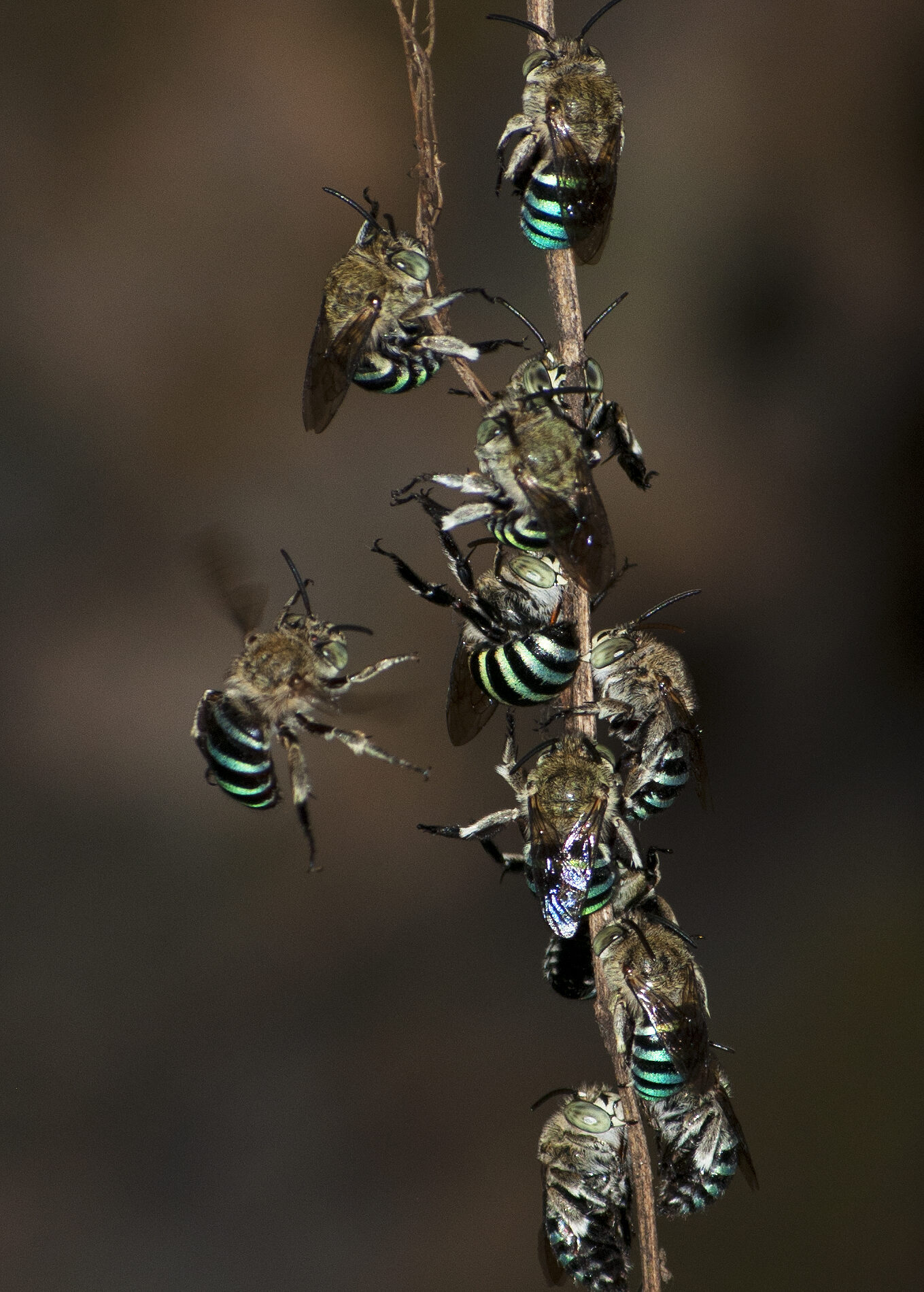
Then another joins him. Then another. Soon, the stem fills up shoulder to shoulder with tiny turquoise-striped bodies, lined neatly against the fading light like patrons claiming their usual spots before last call.
No buzzing over each other. No territorial drama. There’s only an unspoken understanding that this is where the night will be spent.
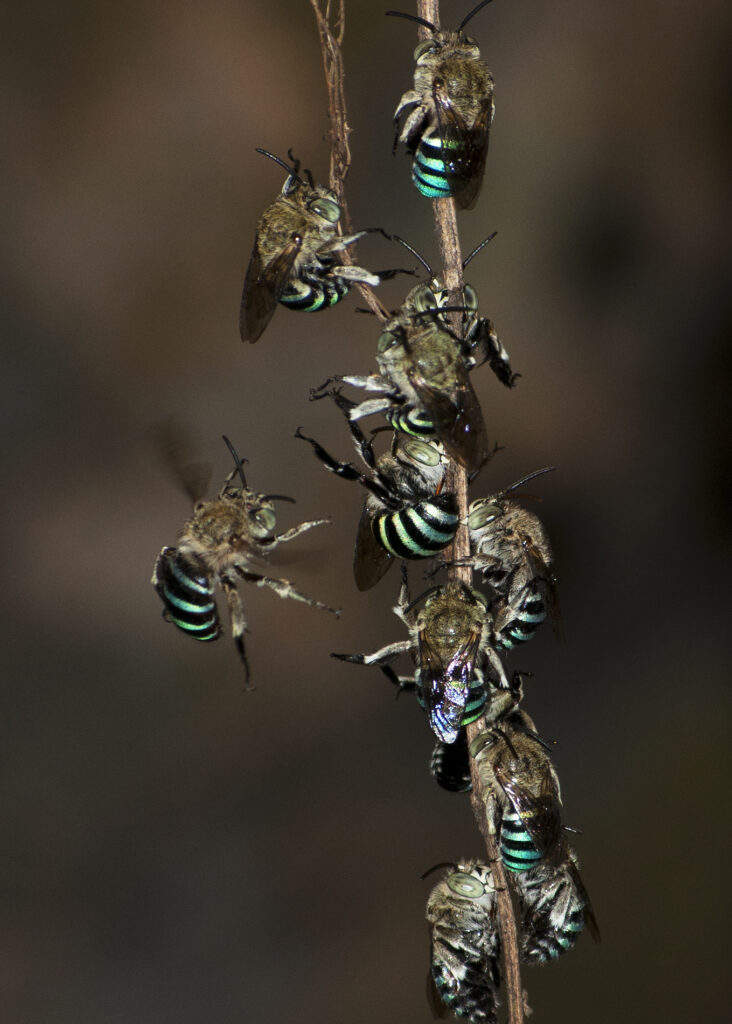
These are male blue-banded bees, Amegilla spp. During the day, they live fast. They streak through gardens and forest edges like flashes of electric blue, rarely still long enough to properly follow. But dusk changes their rhythm entirely.
As daylight signs off, the males gather here to roost together.
Which is surprising, considering blue-banded bees are solitary by nature. They do not belong to colonies. There are no hives waiting for them back home, no queens to report to, no shared responsibilities humming in the background. By morning, each bee will head back out alone again.
But for these few twilight hours, the forest hosts a different kind of social club.
Ecologists believe these nightly gatherings may offer protection from predators. In low light, a cluster becomes harder to distinguish than a solitary insect. The swaying stem itself acts like terrible nightlife infrastructure for anything trying to land precisely enough for an attack. But beyond survival, there is something poetic about the scene.
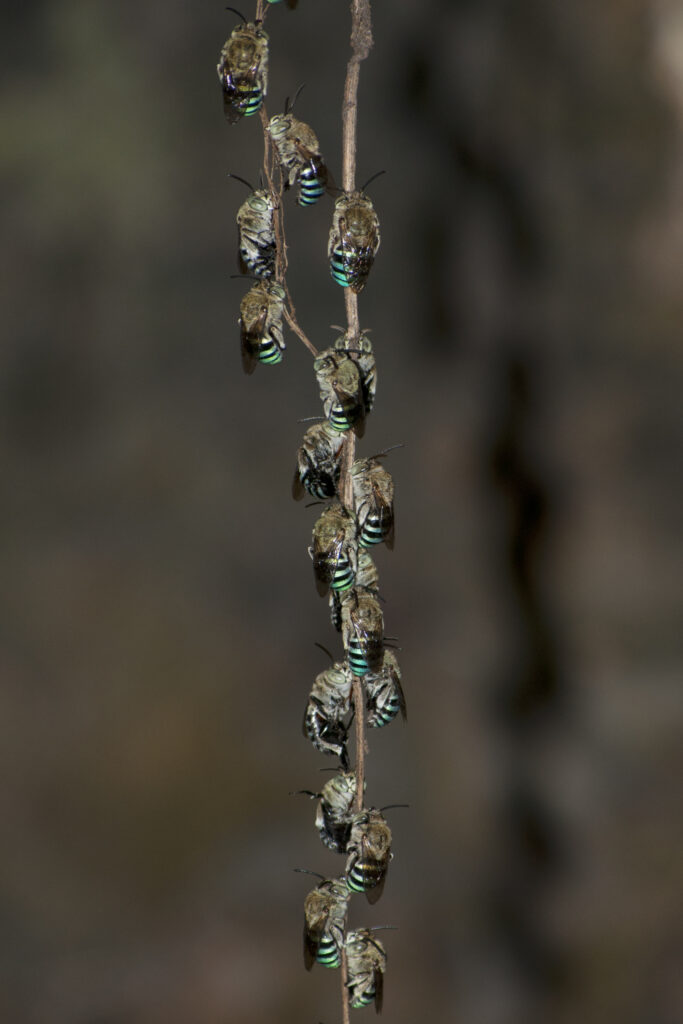
A species built around solitude, choosing company at the end of the day.
Elsewhere, hidden from sight, the females spend the night alone inside carefully built burrows carved into clay banks, sandstone and old walls. Each tunnel holds a single egg provisioned with pollen and nectar, prepared patiently for the next generation. There are no communal nurseries or shared nesting spaces.
Which makes this evening ritual feel even more intimate.
Neither a grand spectacle nor a performance staged for attention. Instead, a handful of bees gather for what might be the forest’s smallest sundowner session, suspended gently between leaf, water and darkness.
Most people never notice it because it happens during nature’s in-between hour. That fleeting moment when cameras go away, conversations fade and attention moves elsewhere.
But the forest doesn’t clock out at sunset.
Sometimes, that’s exactly when the night crowd arrives.