Picture this: you’re looking at a tree and you notice that a leaf is eating another leaf.
Confused, right? So was I.
I stood there for a second, replaying what I had just seen, certain I had misread the scene. Leaves do not eat leaves. But there it was, a curled, faintly yellow-rimmed “leaf” clamped onto the edge of a real one, chewing steadily away.
I went closer to confirm what I was seeing, half expecting it to turn out to be one leaf simply resting in front of another. Maybe a game of overlapping shadows is what I thought. It was not. The leaf that was doing the eating had legs. It had antennae. And when I leaned in, it gave a small, deliberate hop and resettled a few inches away, daring me to lose track of it among the real foliage. I had just met a hooded grasshopper (Teratodes monticollis), and it had very nearly gotten away with the disguise.
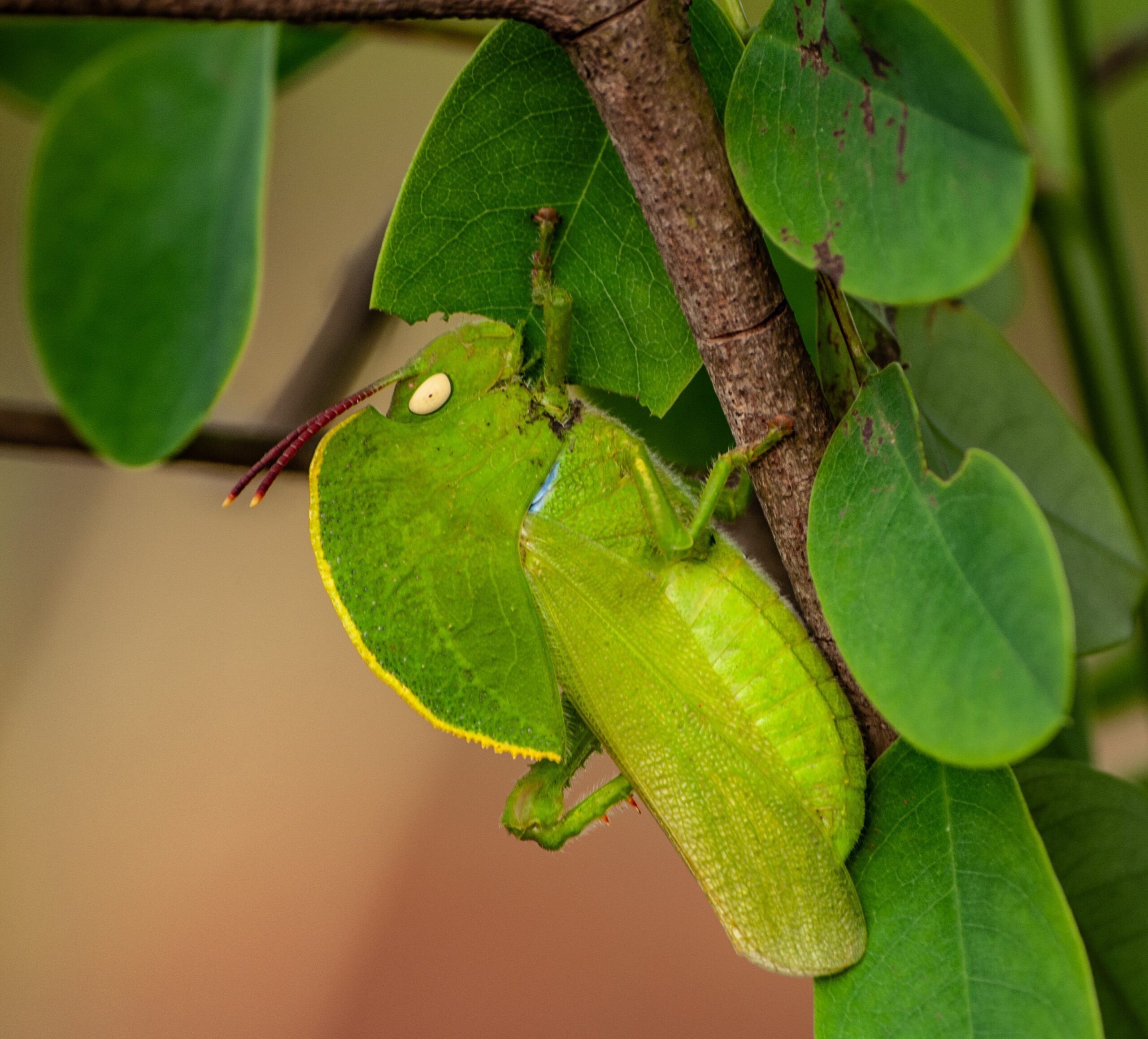
The “leaf” on its back is not a leaf at all, of course. It is the pronotum, the hard plate that sits just behind every grasshopper’s head. Here, it balloons into a tall, sharp-edged hood that arches backward over the body like a cape, rimmed in yellow-orange. Most hooded grasshoppers wear it in a green that matches the foliage around them almost exactly, down to the slight curl and the faint blemish you would expect on an ageing leaf. This is not simply camouflage in the sense of fading into a background. It is a far more specific trick that biologists call masquerading, where an animal does not just blend in but actively resembles one unremarkable object.
It is a trick built to throw off predators that hunt by sight and have already learned, through long experience, that leaves are not worth investigating. Birds and lizards scanning a tree for movement will look straight past a hooded grasshopper sitting still. Their eyes have already clocked that shape as a leaf and moved on.
Not every hooded grasshopper wears the disguise identically. Green is by far the most common colour, but researchers studying the species in Odisha have recorded a small number of individuals in brown. An unusual variation in a species that is otherwise remarkably consistent in its leaf-green costume.
Hooded grasshoppers feed on tree leaves, often showing a strong preference for teak and sandalwood. There’s something almost audacious about an insect that disguises itself as a leaf and then proceeds to eat one. Bold move. The hooded grasshopper pulls it off without a hint of irony. It chews steadily through teak and sandalwood foliage, dressed as the very thing it’s destroying. And when enough of them gather in one place, that appetite stops being charming and starts being a problem.
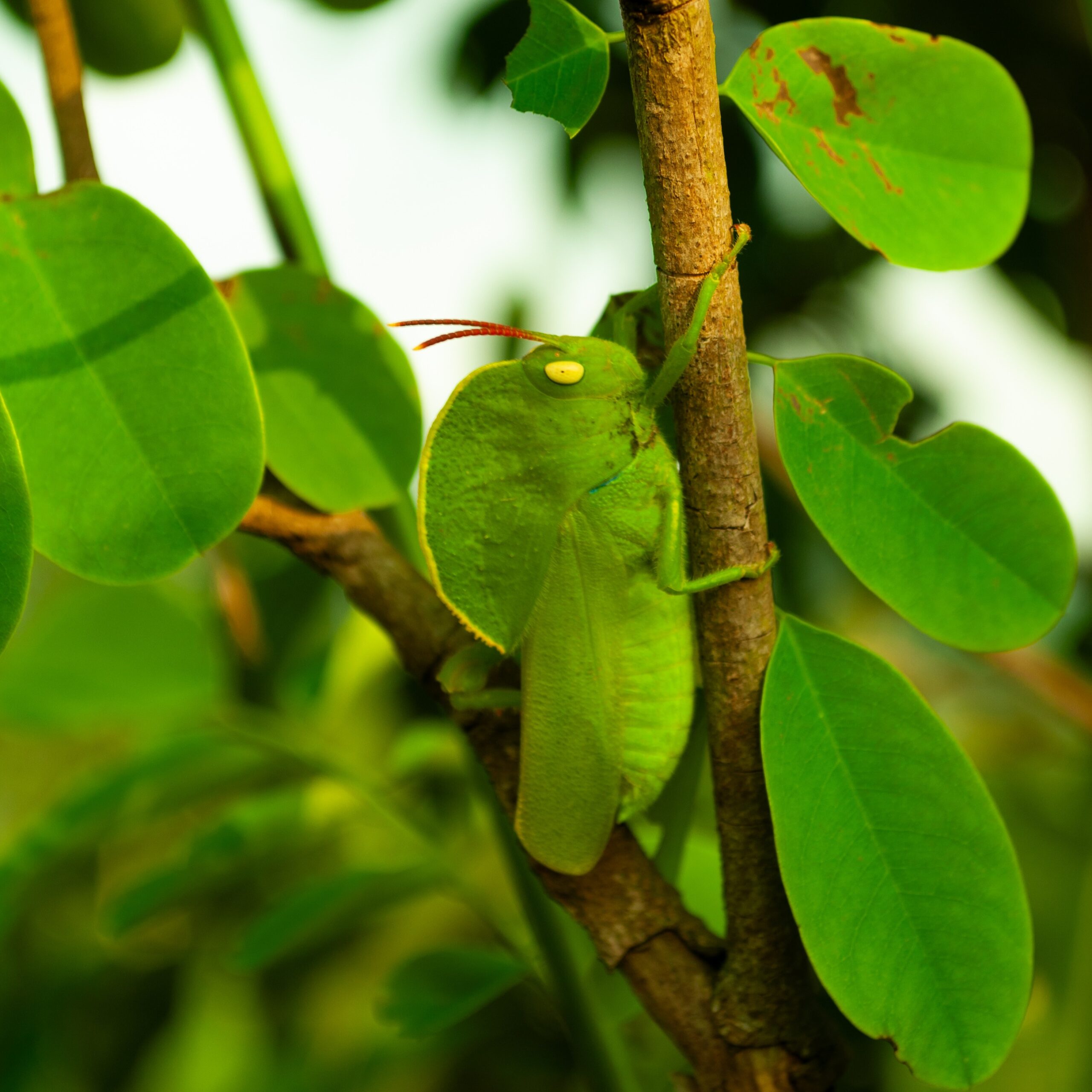
The hooded grasshopper is not a rarity tucked away in some remote forest corner. You can find it across Sri Lanka and India, from Gujarat to Odisha, from Maharashtra to Tamil Nadu and Kerala. It perches openly on shrubs and small trees in dry, scrubby habitats. Out in the open with nowhere to hide. Looking exactly like a leaf isn’t a party trick, it’s the whole plan.
And yet, for all the places you can find it, we know remarkably little about the hooded grasshopper’s behaviour or its role in the ecosystems it moves through. Most of it remains unstudied. India’s invertebrates, particularly its insects, exist in a strange kind of limbo. Too common to seem urgent, too small to generate the kind of attention that draws funding and field time. The larger, more visible animals tend to draw the eye and the resources. The hooded grasshopper asks for none of that. It simply exists in the gaps between the things we have decided are worth paying attention to. In the eyes of the world, it is just a grasshopper — which is perhaps the greatest disguise of all.
This disguise is convincing enough to fool a foraging bird, a passing lizard, and, briefly, me. But every disguise has a tell. Grasshoppers don’t hear the way we do; they listen through tympanal organs, drum-like membranes tucked at the base of their abdomen. They sense vibrations and sound through their belly rather than their head. A leaf, for all its convincing stillness, has never needed ears.
I have walked past hundreds of leaves since that afternoon, and very often I find myself looking a beat too long at one that seems just a little too symmetrical, half expecting it to twitch an antenna and hop away. Most of the time, it is just a leaf. But I keep looking anyway, hoping to be fooled again.