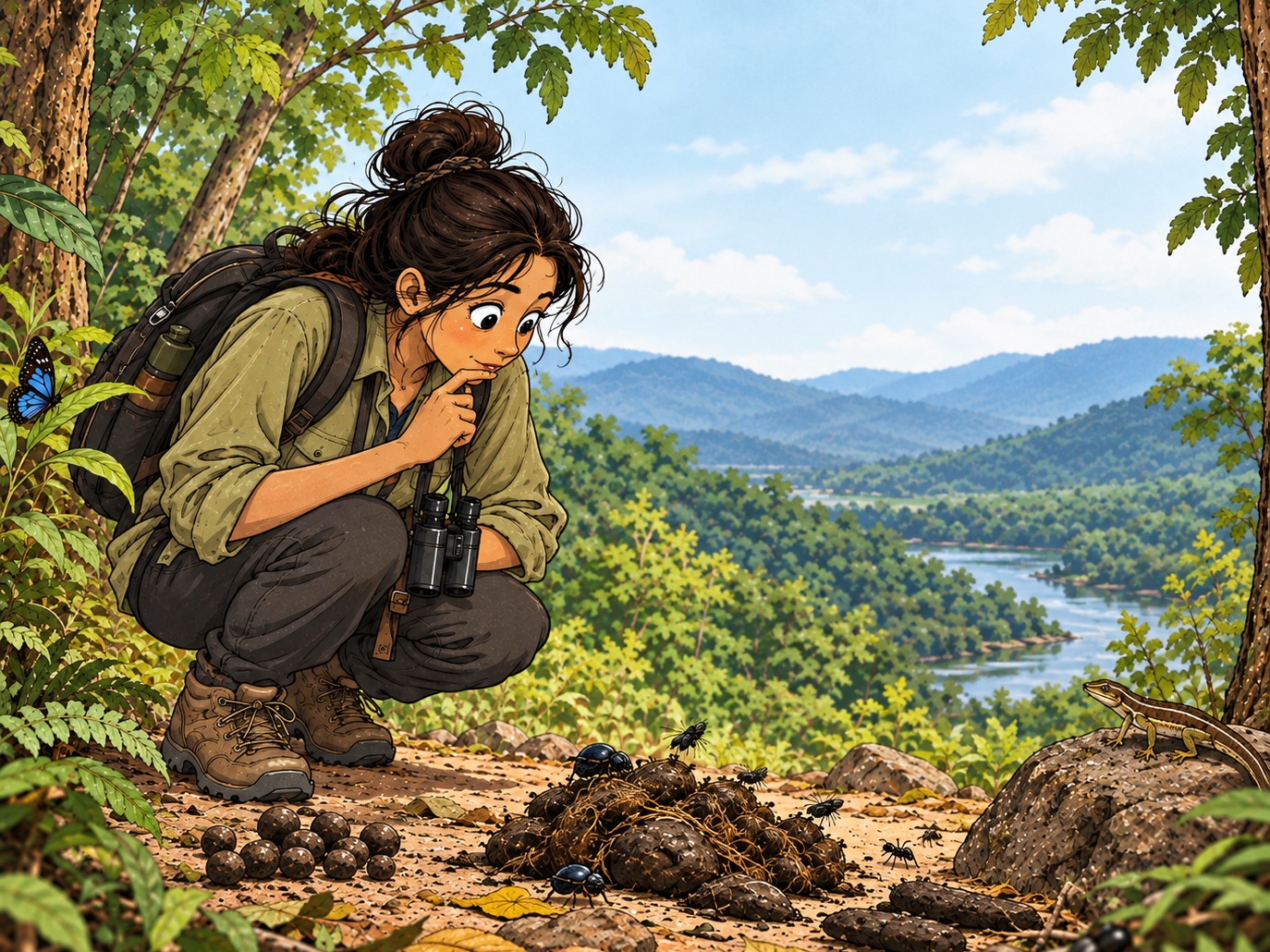
You’re on a trek. The trail is narrow, the forest and its greenery spreads as far as the eye can see, and then you spot something right in the middle of it.
Poop. You stop.
Fresh or old? Pellets or a pile? And, most importantly, who left it here?
Turns out, there’s a lot more to that little discovery than meets the eye.
Welcome to Poop Scoop, where we deconstruct it, piece by piece, and get to the bottom of why poop matters.
1. Give Back Where You Came From
An animal eats.
Its body takes what it needs.
And what comes out still has something to give.
Animal poop contains nutrients that return to the soil as it breaks down. Bacteria, fungi and other decomposers get to work on it, releasing nutrients such as nitrogen and phosphorus back into the ground. Plants can then use these nutrients to grow.
So that fresh, soft dropping sitting on the forest floor isn’t just the end of a meal. It’s part of another cycle beginning. Because in nature, nothing really goes to waste.
2. Every Seed Has a Story to Tell
Some stories begin with a fruit.
An animal eats it, carries on with its day and eventually leaves the seeds behind in its poop.
And just like that, a seed has travelled.
Animals can carry seeds away from the plants they came from and deposit them somewhere new. For some plants, passing through an animal’s digestive system can even help their seeds germinate.
A bird can eat a berry in one part of the forest and leave its seeds somewhere completely different. A fruit-eating mammal can do the same as it moves through its territory.
We tend to think of seeds travelling by wind or water.
But sometimes, they hitch a ride on an animal’s digestive system.
And the ticket?
Well, let’s just say it’s already been processed.
3. One’s Leftover Is Another’s Treasure
You see poop.
An insect like a dung beetle sees opportunity.
Fresh dung provides food and shelter for insects such as dung beetles, flies and their larvae. For dung beetles, it becomes a place to lay eggs and raise their young. So while we’re busy thinking, waste, an entire community might be thinking, where’s the buffet? One animal’s leftovers can become another’s meal.
In the forest, treasure is very much in the eye of the beholder.
4. “I Can Smell It!”
We leave messages everywhere.
A text. A note. A location pin.
Animals have their own ways of saying, “I’ve been here.”
For many species, poop is part of that conversation.
Droppings can contain chemical and scent information that other animals can detect. Moreover, poop is used as territory marking by some species. So by sniffing them, animals can gather clues about who has been around, whether another animal is using an area as territory, and, depending on the species, information about sex, reproductive status and identity.
We see a pile.
Another animal might smell a whole biography.
So perhaps “say it with flowers” isn’t the only way to communicate.
5. Read Between the Lines
The animal isn’t always there. But it leaves signs.
A footprint. A scratch on a tree. A half-eaten fruit.
And, quite often, poop.
These clues can help us to understand which animals have been moving through an area. The size, shape, contents, location and freshness of droppings can all tell us something.
A wet, fresh dropping can suggest a recent visit.
A dry, hardened one that’s beginning to crack and crumble has been around longer.
Put enough of these clues together and you can begin to piece together what happened without ever seeing the animal itself.
The forest has a story.
Sometimes, you just have to read the fine print.
6. The Proof is in the Poop
What comes out of an animal can tell us something about what went in. Droppings, when examined, help us understand what an animal has been eating and learn more about its diet and feeding patterns. In some cases, poop can also provide clues about its health.
Now zoom out.
Put that information together with where the animal has been moving, what plants are growing around it, which other animals are present and what is changing in the landscape.
Suddenly, one little dropping becomes part of a much bigger picture.
A single poop can’t tell us whether an ecosystem is healthy. But enough signs, observed over time, can help researchers understand how an ecosystem is functioning and spot changes that might otherwise be easy to miss.
Sometimes, the proof really is in the pudding.
Just not the kind you’d want to eat.
So the next time you’re walking through a forest and spot a little pile on the trail, maybe pause before walking past it and notice the details.
And if you’re wondering how anyone could possibly look at a pile of poop and figure out who left it… That’s where things get even more interesting.
Because poop isn’t one-size-fits-all.
In the next Poop Scoop, we’re getting into the details. Stay tuned!